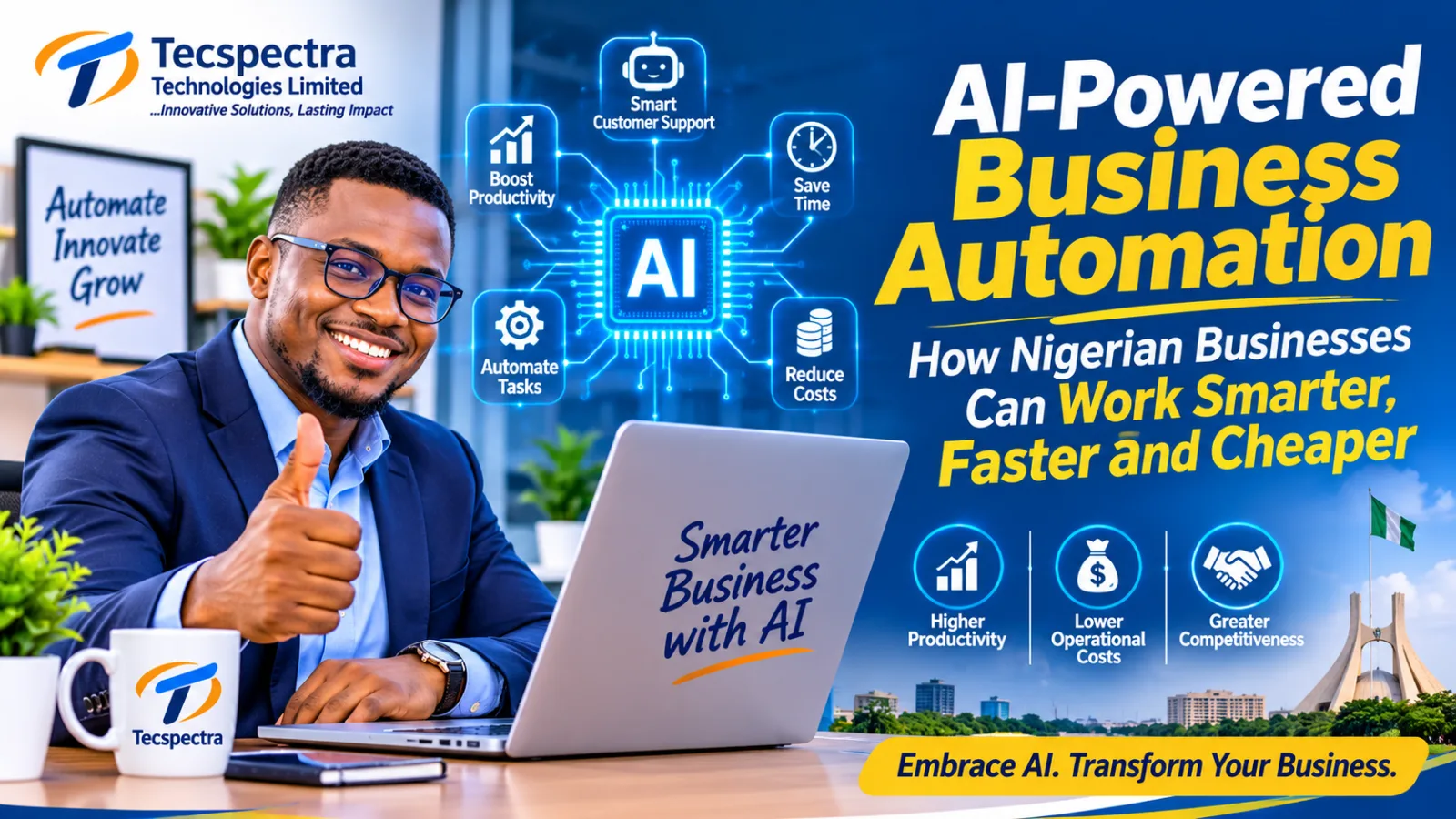
AI-Powered Business Automation: How Nigerian Businesses Can Work Smarter, Faster and Cheaper
For Nigerian businesses, particularly small and medium-sized enterprises (SMEs), embracing intelligent automation presents an opportunity to overcome operational challenges, reduce unnecessary costs and compete more effectively in an increasingly digital economy.
AI-Powered Business Automation: How Nigerian Businesses Can Work Smarter, Faster and Cheaper
Artificial Intelligence is changing how businesses operate, compete and deliver services. From automating customer support and managing business records to processing invoices, generating reports and streamlining daily operations, AI-powered automation is helping businesses reduce repetitive tasks, improve productivity and make better decisions.
For Nigerian businesses, particularly small and medium-sized enterprises (SMEs), embracing intelligent automation presents an opportunity to overcome operational challenges, reduce unnecessary costs and compete more effectively in an increasingly digital economy.
Introduction: A New Era of Business Operations
Running a business in Nigeria comes with its own challenges. Business owners and managers must deal with rising operating costs, staff management, customer expectations, administrative workloads, competition and the constant need to improve efficiency.
Unfortunately, many businesses still depend heavily on manual processes to manage everyday operations. Customer enquiries are answered individually, sales records are maintained manually, invoices are prepared one after another, and business reports are compiled from multiple spreadsheets.
While these methods may work when a business is small, they can become inefficient as the organisation grows. They consume valuable time, increase the possibility of human error and make it difficult for business owners to focus on strategic activities.
This is where Artificial Intelligence (AI) and business automation become valuable.
Modern AI technologies can help businesses understand customer enquiries, generate responses, analyse information, classify documents and support decision-making. When combined with automation platforms, these capabilities can trigger actions across different business applications with minimal manual intervention.
The result is a smarter way of working, where people spend less time on repetitive activities and more time on activities that require creativity, judgement, relationships and strategic thinking.
1. What Is AI-Powered Business Automation?
AI-powered business automation is the use of Artificial Intelligence, software applications and automated workflows to perform or assist with business tasks that would otherwise require manual effort.
Traditional automation follows predefined instructions. For example, a system may automatically send an email whenever a customer submits a registration form.
AI-powered automation goes further by introducing capabilities such as understanding natural language, extracting information from documents, recognising patterns, generating content and classifying customer requests.
Consider a business that receives hundreds of customer enquiries every month. A traditional automated system might send the same predefined response to everyone. An AI-powered system could interpret the customer's question, identify the relevant service and suggest an appropriate response based on approved business information.
These technologies can work together to create intelligent workflows that improve speed, consistency and operational efficiency.
AI versus Traditional Automation
| Traditional Automation | AI-Powered Automation |
|---|---|
| Follows predefined rules. | Can interpret information and respond to context. |
| Handles structured, predictable tasks. | Can assist with complex and less structured information. |
| Sends predefined messages. | Can generate context-aware responses. |
| Works within fixed instructions. | Can use AI models to classify, summarise and analyse information. |
| Requires rules for each workflow. | Can handle some variations in user input and information. |
It is important to understand that AI does not replace the need for proper business processes. The best results often come from combining conventional automation, AI capabilities and human supervision.
2. Seven Ways Nigerian Businesses Can Use AI Automation
A. Automated Customer Support and Enquiry Management
Customer support is one of the most practical areas where businesses can benefit from AI automation.
Many Nigerian businesses receive enquiries through WhatsApp, websites, social media, email and telephone calls. Responding to every enquiry manually can become time-consuming, especially during busy periods.
AI-powered chatbots and virtual assistants can help businesses respond to frequently asked questions, provide product information, explain service offerings, collect customer details and direct enquiries to the appropriate department.
Practical examples:
- A school can automate responses to questions about admission, tuition fees, academic programmes and registration procedures.
- An online retailer can provide product information, delivery updates and order assistance.
- A hotel can automate room enquiries, booking information and frequently asked questions.
- A professional services firm can collect client requirements before assigning enquiries to its consultants.
These systems can provide faster responses and help ensure that potential customers are not ignored simply because staff members are unavailable.
B. Automated Invoicing, Billing and Financial Administration
Preparing invoices, tracking payments and maintaining financial records are important but repetitive business activities.
Businesses can automate these processes using accounting software and integrated workflow systems.
Possible applications include:
- Automatically generating invoices after a confirmed order.
- Sending payment reminders to customers.
- Recording transactions in accounting systems.
- Generating sales and expense summaries.
- Extracting information from receipts and financial documents.
- Preparing periodic financial reports for review.
For example, a consulting company can configure its business application to generate an invoice immediately after a service order is approved. A payment notification can then trigger an update to the customer's account and notify the relevant staff.
AI can also assist with categorising expenses and identifying unusual transaction patterns. However, financial transactions, tax calculations and statutory reporting should remain subject to appropriate accounting controls and professional review.
C. Inventory and Stock Management
Poor inventory management can result in stock shortages, overstocking, expired products and unnecessary financial losses.
AI-assisted inventory systems can analyse historical sales, identify purchasing patterns and help businesses estimate future stock requirements.
Examples include:
- Automatic low-stock notifications.
- Sales trend analysis.
- Demand forecasting.
- Stock movement monitoring.
- Product performance reports.
- Automated purchase order preparation for approval.
A supermarket, pharmacy or distribution company can use these capabilities to make better purchasing decisions and reduce avoidable inventory costs.
D. Human Resources and Employee Management
Human resource departments handle several administrative responsibilities, including employee records, attendance, leave applications, recruitment and performance documentation.
Automation can simplify many of these activities and improve the organisation of employee information.
Practical applications include:
- Automated leave application and approval workflows.
- Employee onboarding checklists.
- Attendance and timesheet processing.
- Generating HR summaries and reports.
- Organising employee documents.
- Assisting with recruitment administration.
AI can help summarise applications and organise candidate information, but recruitment decisions, performance assessments and other consequential employment decisions should involve accountable human judgement.
E. Sales and Marketing Automation
Finding potential customers, following up on enquiries and maintaining customer relationships are essential to business growth.
AI-powered marketing and customer relationship management (CRM) systems can help businesses organise prospects, automate communications and understand customer behaviour.
Examples include:
- Automatically capturing leads from website forms.
- Sending scheduled follow-up messages.
- Organising customers according to their interests.
- Generating marketing content and campaign ideas.
- Preparing sales performance reports.
- Identifying inactive customers for follow-up.
A real estate company, for example, can use a CRM platform to record property enquiries, categorise prospective buyers and schedule follow-ups based on their stated requirements.
F. Document Processing and Records Management
Many organisations still spend significant time processing paper documents, registration forms, receipts, applications and other administrative records.
AI-powered document processing tools can extract text, identify important information, classify documents and transfer selected data into business systems.
Possible applications include:
- Extracting information from application forms.
- Digitising paper records using OCR technology.
- Classifying incoming documents.
- Summarising long reports and correspondence.
- Organising digital archives.
- Routing documents to the appropriate department.
This can be particularly useful for schools, hospitals, consulting firms, government contractors and organisations managing large volumes of records.
G. Business Reporting and Decision Support
Business owners need reliable information to understand performance, identify problems and make strategic decisions.
However, preparing reports manually from multiple sources can be difficult and time-consuming.
Integrated business intelligence and AI tools can help organisations collect, analyse and present information through dashboards and automated reports.
Examples include:
- Daily and monthly sales reports.
- Revenue and expense summaries.
- Customer behaviour analysis.
- Employee productivity reports.
- Inventory performance dashboards.
- Automated business performance summaries.
Rather than spending hours compiling spreadsheets, managers can review organised dashboards and focus on understanding what the information means for their businesses.
3. AI and Automation Tools Businesses Can Start Using
One common misconception is that implementing AI automation requires an expensive technology infrastructure or a large team of software developers.
While advanced automation projects may require custom software development and integration, several accessible tools can help businesses begin their automation journey.
AI Assistants and Productivity Tools
- ChatGPT: Can assist with drafting business documents, research, customer response templates, data interpretation and everyday productivity.
- Google Gemini: Supports research, content generation, information analysis and workflows within supported Google services.
- Microsoft Copilot: Helps users work with documents, spreadsheets, presentations and other supported Microsoft applications.
- Claude: Can assist with document analysis, writing, reasoning and other knowledge-work activities.
Workflow Automation Platforms
- Zapier: Connects different applications and automates workflows between supported services.
- Make: Provides visual tools for creating multi-step automated workflows and application integrations.
- n8n: Offers flexible workflow automation and integration capabilities, including self-hosting options.
- Microsoft Power Automate: Helps organisations automate repetitive tasks and connect supported business applications.
Business Management and Analytics Tools
- Microsoft Power BI: Helps businesses transform data into interactive reports and dashboards.
- HubSpot: Provides CRM, sales and marketing automation capabilities.
- Zoho: Offers business applications for CRM, accounting, human resources and other operational needs.
- Odoo: Provides integrated business management applications, including inventory, sales, accounting and CRM.
The right tool depends on the size of the business, its operational requirements, budget, existing software and integration needs. Businesses should evaluate subscription costs, data handling policies, local payment options and long-term support before making a commitment.
4. Practical Examples Across Nigerian Industries
AI automation is not limited to technology companies. Businesses across different sectors can benefit from intelligent digital workflows.
| Industry | Potential Automation |
|---|---|
| Education | Student registration, fee notifications, admission enquiries and academic reporting. |
| Retail and E-commerce | Order processing, inventory alerts, customer support and sales reporting. |
| Healthcare | Appointment scheduling, administrative records and patient enquiry management. |
| Agriculture | Farm record management, weather information processing and agricultural advisory support. |
| Real Estate | Property enquiries, lead management, client follow-ups and document organisation. |
| Professional Services | Client onboarding, document preparation, invoicing and project reporting. |
| Logistics | Order tracking, delivery notifications, dispatch coordination and reporting. |
| Hospitality | Reservations, customer enquiries, booking confirmations and feedback collection. |
These are practical opportunities rather than one-size-fits-all solutions. Every organisation should identify its specific operational problems before selecting an automation system.
5. How Small and Medium-Sized Businesses Can Get Started
Businesses do not have to automate everything at once. In fact, attempting to transform every department simultaneously can create unnecessary complexity and costs.
A gradual, problem-driven approach is often more effective.
Step 1: Identify Repetitive Business Activities
Examine daily operations and identify tasks that consume significant staff time. These may include answering repetitive questions, preparing invoices, entering customer records, generating reports or sending reminders.
Step 2: Prioritise High-Impact Processes
Select a task that occurs frequently, follows a reasonably consistent process and can be automated without introducing unacceptable risks.
For example, automating customer enquiry collection may be a better starting point than automating complex financial approvals.
Step 3: Choose the Right Technology
Determine whether a ready-made application, workflow automation platform or custom-developed solution is appropriate.
Consider the software your organisation already uses, integration requirements, internet connectivity, data security, subscription fees and staff capabilities.
Step 4: Start with a Small Pilot Project
Implement the proposed automation in one department or for a limited group of users. Monitor its performance and identify problems before expanding it across the organisation.
Step 5: Train Employees
Automation works best when employees understand how to use the new systems. Provide practical training and explain how their responsibilities may change.
Step 6: Measure Results
Compare performance before and after implementation. Useful indicators include:
- Time required to complete a task.
- Administrative cost per transaction.
- Customer response and resolution times.
- Frequency of processing errors.
- Employee productivity.
- Customer satisfaction.
A successful automation project should deliver measurable business value, not simply introduce another technology product into the organisation.
6. How Much Can Business Automation Save?
One of the strongest reasons to adopt automation is the potential to reduce the time and resources spent on repetitive work.
Consider a hypothetical Nigerian business with five employees who each spend two hours every working day performing repetitive administrative tasks.
Assuming 22 working days per month:
- 5 employees × 2 hours = 10 staff hours daily.
- 10 hours × 22 working days = 220 hours monthly.
- That is approximately 220 staff hours spent on repetitive activities every month.
If a properly implemented automation system reduces this workload by half, the business could recover approximately 110 staff hours per month.
These recovered hours can be redirected towards customer engagement, sales, service delivery and other productive activities.
This is an illustrative example, not a guaranteed saving. Actual results depend on the processes involved, automation quality, implementation costs and employee adoption.
Understanding the Return on Investment (ROI)
Businesses should evaluate automation using a simple return-on-investment framework:
ROI (%) = [(Financial Benefits - Total Automation Costs) ÷ Total Automation Costs] × 100
Financial benefits may include reduced administrative expenses, fewer processing errors, improved productivity and additional revenue opportunities. Costs may include software subscriptions, implementation, training, maintenance and integration.
Time saved is valuable, but it should not automatically be treated as cash saved. Businesses should distinguish between recovered employee capacity and actual reductions in expenditure.
7. Challenges and Risks Businesses Must Consider
Although AI automation offers significant opportunities, implementation should be approached carefully.
Data Privacy and Security
Business systems often contain sensitive customer, employee and financial information. Organisations must understand how their chosen tools collect, process, store and share data.
Businesses operating in Nigeria should consider their obligations under the Nigeria Data Protection Act 2023 and applicable data protection requirements.
Incorrect AI Outputs
AI systems can generate inaccurate information or produce convincing but incorrect responses. Important business decisions, financial records and customer commitments should not rely entirely on unverified AI outputs.
Implementation Costs
Some automation platforms require recurring subscriptions, integration expenses or specialised technical expertise. Businesses should evaluate the total cost of ownership before adopting a solution.
Employee Resistance and Skills Gaps
Employees may be concerned about changes to their roles or may lack the skills needed to operate new systems. Effective communication, training and employee involvement are essential.
Internet and Infrastructure Challenges
Some cloud-based automation systems depend on reliable internet connectivity and external services. Nigerian businesses should consider connectivity costs, power availability, backup arrangements and offline alternatives when designing their systems.
Human Oversight and Accountability
Automation should not eliminate accountability. Businesses should define who approves transactions, handles exceptions, reviews AI-generated content and responds when systems fail.
The goal is to make people more productive, not to remove human judgement from decisions that require it.
8. Why Custom Business Automation Solutions May Be Necessary
Ready-made software and automation platforms are excellent starting points. However, some businesses have unique processes that cannot be adequately addressed by generic applications.
A school may need an integrated platform connecting student admissions, fee payments, attendance, examinations and parent notifications. A logistics company may require a system that connects order management, dispatch, delivery tracking and customer communication.
In such situations, custom software development and application integration can provide a more suitable solution.
A properly designed automation system can connect different departments, eliminate duplicate data entry, centralise records and provide management with a clearer view of business operations.
Businesses should not adopt custom software simply because it sounds more advanced. The decision should be based on operational requirements, expected benefits, integration needs and long-term costs.
Conclusion: The Future Belongs to Smarter Businesses
AI-powered business automation is changing how organisations manage their operations, interact with customers and make decisions.
For Nigerian businesses, it presents an opportunity to reduce repetitive workloads, improve service delivery, strengthen operational controls and compete more effectively in the digital economy.
However, successful automation is not about adopting every new AI tool or replacing every manual process. It is about identifying the right problems, selecting appropriate technologies and implementing solutions that deliver measurable results.
Businesses that begin with practical, manageable projects and continuously improve their digital capabilities will be better positioned to benefit from the opportunities emerging in the AI era.
The question is no longer whether businesses should embrace automation. The more important question is how effectively they can use it to create value.
Ready to Automate and Transform Your Business?
At Tecspectra Technologies Limited, we help businesses leverage technology to improve operations, increase productivity and achieve sustainable growth.
Our services include:
- Custom software and web application development.
- AI integration and business process automation.
- Business management systems and enterprise portals.
- Database design and management.
- Cloud infrastructure and IT consulting.
- Digital transformation and technology training.
Whether you want to automate a single business process or develop an integrated digital management platform, Tecspectra can help you identify the right technology and implement a practical solution.
Work Smarter. Automate Better. Grow Faster.